Stage by Stage: Why implementing Achiever LIMS doesn’t need to disrupt your lab
Changing a Laboratory Information Management System (LIMS) is often seen as one of the most challenging projects a laboratory can undertake. Unlike replacing a single instrument or introducing a new test method, implementing a LIMS touches almost every part of the operation. Samples still need to be processed, reports still need to be issued and customers still expect the same level of service throughout the transition. It’s understandable that many laboratories worry more about the implementation process than the software itself.
In reality, successful LIMS projects are rarely defined by the technology alone. They succeed because there is a clear methodology behind them, one that breaks a complex project into manageable stages, involves laboratory staff from the outset and focuses on delivering measurable improvements rather than unnecessary change. At Interactive Software, that’s exactly how every Achiever LIMS implementation is approached.
A foundation built on value, not complexity
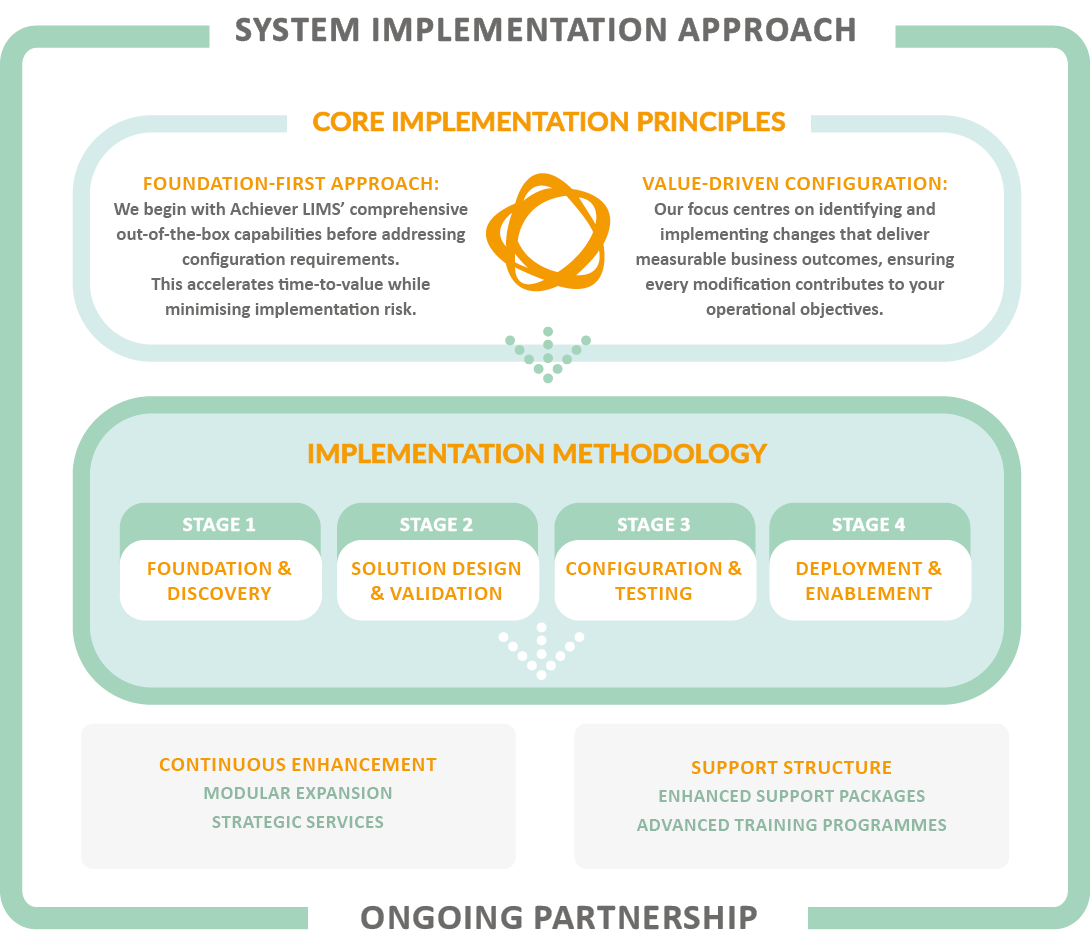
Every Achiever LIMS implementation is guided by two core principles that shape the entire project. The first is a foundation-first approach. Rather than immediately configuring every possible feature, the implementation begins by understanding how the laboratory operates today and making the most of Achiever LIMS’ comprehensive out-of-the-box functionality. This allows laboratories to realise value more quickly while reducing implementation risk and avoiding unnecessary complexity.
Alongside this sits a value-driven configuration philosophy. Every laboratory has unique requirements, but not every request delivers genuine operational value. Instead of recreating existing processes simply because they’ve always been done that way, Interactive Software works with customers to identify the changes that will have the greatest impact on efficiency, traceability and laboratory performance. The result is a system configured around meaningful outcomes rather than excessive customisation.
Stage One: Foundation & Discovery
Every implementation begins with understanding the laboratory, not the software. This discovery stage is an opportunity to explore existing workflows, identify pain points and define what success looks like once the new system is in place. Discussions typically cover everything from sample registration and testing workflows to reporting requirements, instrument integrations and regulatory obligations.
This stage is equally important for Interactive Software and the laboratory team. It ensures everyone shares the same understanding of the project objectives before configuration begins. Investing time here helps prevent misunderstandings later and creates a clear roadmap for the remainder of the implementation.
Stage Two: Solution Design & Validation
Once the laboratory’s requirements have been established, attention turns to designing the solution. Existing workflows are reviewed, opportunities for automation are identified and the system is configured to support the way the laboratory operates rather than forcing users to adopt unnecessary workarounds.
Validation forms an important part of this stage. Before any configuration is finalised, proposed workflows and functionality are reviewed to ensure they meet operational needs, compliance requirements and long-term business objectives. This collaborative approach allows adjustments to be made early, reducing both project risk and implementation time.
Stage Three: Configuration & Testing
With the design agreed, the implementation team begins configuring Achiever LIMS. Workflows, user roles, dashboards, reports and instrument integrations are developed in line with the agreed specification, creating a system tailored to the laboratory’s operational requirements.
Configuration, however, is only part of the process. Thorough testing ensures every workflow performs as expected before the system is introduced into the live environment. Laboratory users can work through realistic scenarios using representative data, providing valuable feedback while becoming familiar with the new system. By the time deployment approaches, the software already feels like a natural extension of the laboratory rather than an unfamiliar tool.
Stage Four: Deployment & Enablement
Deployment is often perceived as the most daunting part of a LIMS project, but a structured implementation significantly reduces that risk. Because users have already been involved throughout discovery, design and testing, go-live becomes a planned transition rather than a sudden change.
Training is tailored to different user groups, ensuring analysts, quality managers, laboratory managers and system administrators all understand how Achiever LIMS supports their specific responsibilities. The objective is not simply to deliver a working system, but to ensure laboratory staff have the confidence to use it effectively from day one.
An ongoing partnership
The implementation may have a defined endpoint, but the relationship does not. Laboratories continually evolve as workloads increase, new instruments are introduced and regulatory requirements change. Achiever LIMS is designed to evolve alongside those changes, supported by modular expansion, ongoing consultancy, enhanced support packages and additional training where required.
This long-term partnership is an important part of the implementation philosophy. Rather than delivering a system and moving on, Interactive Software works with laboratories to ensure Achiever LIMS continues to provide value long after the initial deployment.
A structured approach delivers lasting results
Successful LIMS implementations are built on preparation, collaboration and realistic planning. By following a structured methodology, from Foundation & Discovery through to Deployment & Enablement, Interactive Software helps laboratories introduce Achiever LIMS in a controlled and manageable way, reducing disruption while delivering measurable operational improvements.
A new LIMS should never feel like an interruption to laboratory operations. With the right implementation approach, it becomes the foundation for a more efficient, connected and resilient laboratory for years to come.

Comments are closed.