
Achiever LIMS - A practical, phased implementation approach
Successful LIMS implementation depends on treating the programme as an operational change initiative rather than a software installation.
At Interactive Software our focus centres on implementing changes that deliver measurable business outcomes.
Labs typically benefit from phased delivery, prioritising high-value workflows early while maintaining service continuity. A phased implementation roadmap reduces delivery risk, while an Return on Investment (ROI) framework ensures benefits are measured and sustained.
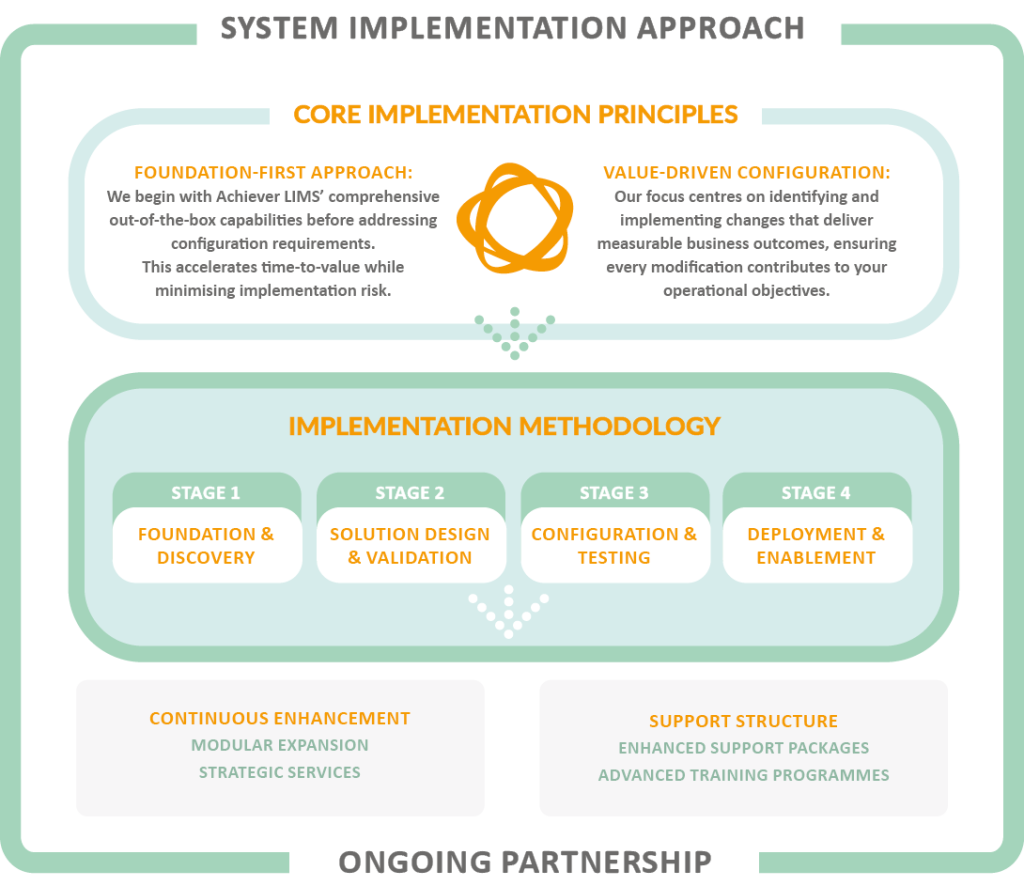
Methodology for a successful Achiever LIMS implementation
With over two decades of experience, we have supported laboratories across a range of sectors, including pre-clinical and clinical research, academic institutions, agritech, environmental science, and biorepositories, to implement successful, transformative software solutions.
LIMS implementations succeed because there is a clear methodology behind them, one that breaks a complex project into manageable stages, involves laboratory staff from the outset and focuses on delivering measurable improvements rather than unnecessary change. At Interactive Software, that’s exactly how every Achiever LIMS implementation is approached.
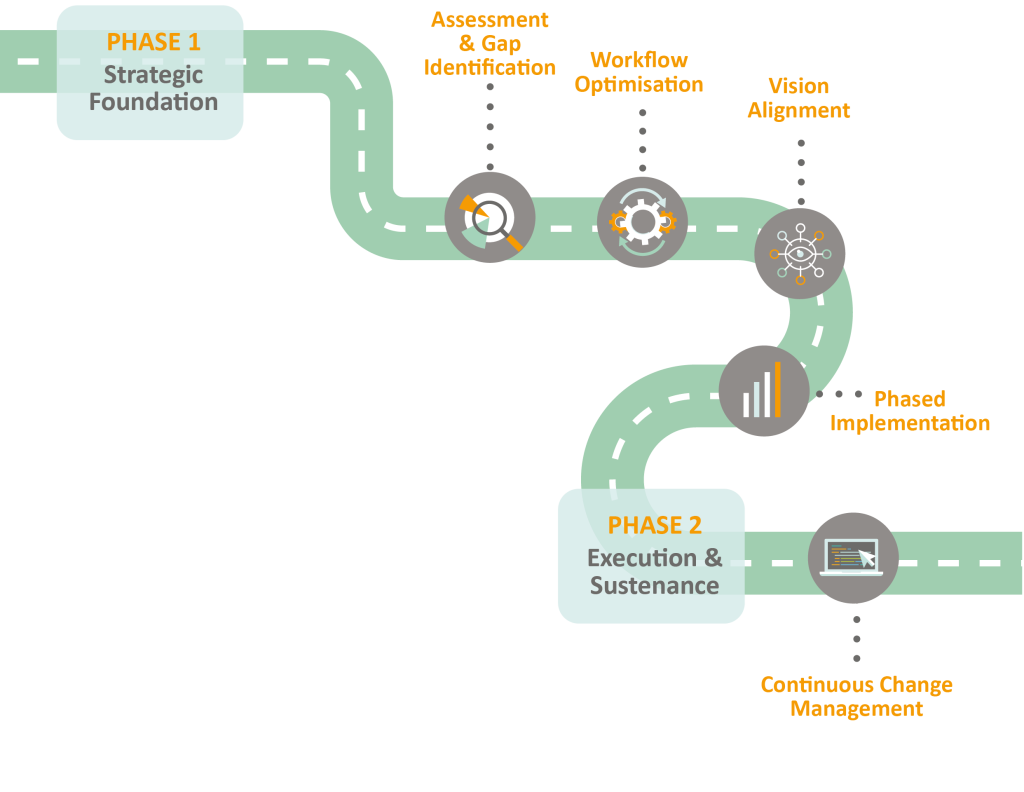
Defining a clear future vision is essential when implementing a LIMS. As is aligning that vision with broader organisational goals.
LIMS Implementation is most effective when delivered in phases, allowing for incremental improvements and reduced risk. Our proven, phased implementation approach defines key milestones and validates critical deliverables before proceeding.
Change management plays a critical role throughout. Early engagement with teams, clear communication, and ongoing support help ensure successful adoption and long-term value.
Role-based training and structured issue management support adoption during stabilisation, when refinements are expected.
Once the LIMS has been launched, labs can build additional innovation on top of the digital foundation.
We work with the lab to understand current processes, where time and risk build up, and what success looks like after go-live. Process mapping keeps scope controlled and ensures the design reflects reality, while baseline metrics enable measurable ROI.
Together with lab teams, we translate operational needs into clear requirements, sample types, workflows, method logic, integrations, reporting, data retention, and user roles, aligned to accreditation and governance. A well-defined design reduces scope creep and supports effective validation planning.
We configure the LIMS to match lab operations, including registration templates, workflows, test packages, calculations, approvals, and reporting. We account for matrix-specific rules, throughput changes, and differing reporting formats.
Go-live is planned around what must be operational from day one. Labs typically migrate key master data and essential history first, keeping older records read-only where needed. Integrations can be phased, starting with high-volume or high-risk areas, supported by structured testing to confirm workflows, calculations, integrations, and reports perform as expected.
Professional Services
Successful LIMS implementations are built on preparation, collaboration and realistic planning. By following a structured methodology, from Foundation & Discovery through to Deployment & Enablement, our team helps laboratories introduce Achiever LIMS in a controlled and manageable way, reducing disruption while delivering measurable operational improvements.
Project Management
Planning and change management
LIMS Consultancy
Unlocking your requirements
Training & Testing
Transferring knowledge
Taking control of your data
Data migration is often one of the most time‑consuming parts of a LIMS project, especially for labs moving from spreadsheets or legacy systems. Clean, consistent data is essential for a smooth transition.
This means reviewing existing datasets, removing duplicates, standardising naming conventions, and validating historical results. It’s worth investing the time here, poor‑quality data can undermine even the best‑configured LIMS. Think of it as laying the foundation for everything that follows.
Our data guide helps you identify and overcome your data challenges to move confidently from spreadsheets to a centralised, compliant, and efficient data management platform.

Ongoing support and assistance
To us, you’re not just “Client #4821”. You’re a real team, doing real work, with real pressures.
Our dedicated Helpdesk team are available to assist your team with any questions and issues as they arise.

Catch up on our latest blogs for implementation hints and tips


Accelerating Agritech lab performance: How a LIMS optimises workflows
10th September 2026
Read More »